I guess the reason I have never been swept up in Shakespeare is because I don't understand him. While reading his sonnets, I was constantly asking "what is he talking about?" The structure of his phrases is of course confusing, but I want to know, is he talking about
a woman
a friend
a season
a flower
is he serious
is this sarcastic
is this honest
is the subject real
is this a code word for something else
a specific incident
his imagination
Sonnet 116 caught my attention. For all of the unstable ground I tripped on while reading his sonnets, his point seemed clear to me in this one. Love cannot be altered or changed - it is what it is. "Love's not time's fool..." I guess I would have to fall truly in love to find out if what he's saying is true. Do you believe that love is not time's fool? And if love is so stable, the ever fixed mark, why are relationships so frustrating? Is he saying that we are lost without love? Maybe, a frustrating relationship is devoid of real love...
IDK. I'll let you know if/when I find out.
Thursday, April 23, 2009

Wednesday, April 22, 2009
straight up trippin
I have gone over my artistic statement about 68435687635739157 times trying to make sure I did it correctly. I think the more I went over it, the more I ruined it. I became so concerned with covering the points in our handout and not just expressing my purpose... It doesn't help to constantly stare at the computer screen, I think that melts my brain even more.
What is it about the artistic statement that has me straight trippin? (haha ok I know that's not how I talk but that's how I feel right now, reduced to base language) I think it's because I've only done several artistic statements before, and they have only been about one page in length. I also think I'm tripped up over the statement because the more I read through my work and review it, the less objective I become. It's like the paper lives in my mind, and I know exactly what I am trying to say, and it makes perfect sense to me, but I can't see it as it is written in black and white. It's like my brain auto-corrects what's on paper, and I can't objectively look at my it. This is why you always need a second set of eyes for editing, because they look at the paper exactly as it is written.
On a different note, when I was googling artistic statements, I came across a website that gave artists the objectives of an artistic statement. The usual suspects ensued..... what do I want to say? How is this different from other works of art? Why is this important? Why did I do this? But the really interesting part of the website was a quote that reads as follows
What is it about the artistic statement that has me straight trippin? (haha ok I know that's not how I talk but that's how I feel right now, reduced to base language) I think it's because I've only done several artistic statements before, and they have only been about one page in length. I also think I'm tripped up over the statement because the more I read through my work and review it, the less objective I become. It's like the paper lives in my mind, and I know exactly what I am trying to say, and it makes perfect sense to me, but I can't see it as it is written in black and white. It's like my brain auto-corrects what's on paper, and I can't objectively look at my it. This is why you always need a second set of eyes for editing, because they look at the paper exactly as it is written.
On a different note, when I was googling artistic statements, I came across a website that gave artists the objectives of an artistic statement. The usual suspects ensued..... what do I want to say? How is this different from other works of art? Why is this important? Why did I do this? But the really interesting part of the website was a quote that reads as follows
"Too much self-analysis lets the air out of your creative balloon." Edward Betts
Now, if that's not ironic because of the use of balloons, I don't know what is (remember I talked about a balloon theory in my presentation). And, it's interesting because it goes back to conversations we've had about expressing yourself in a dignified manner and not giving away too much information. I think the statement also touches on the fact that too much of anything, self-analysis in particular, can send you on a head trip. I found this quote on Nita's art blog.
Thursday, April 16, 2009
Surprise Surprise!
For my second paper I am working with Cereta, which is shocking, I know. I am conversing with her as Petrarch did with Augustine in My Secret.
In the name of self-analysis, I took a quiz on my level of confidence. My result is as follows
At any rate, I'm enjoying the assignment!

Thinking about the questions for her to ask me, and thinking about my responses has been quite a trip. It really requires a lot of self exploration, and not just pondering, but reeeaaallly questioning myself.
I find myself being quite self-conscious because I still want to present myself honorably, but I want to be truthful. I'm also trying to emulate Cereta's pretty style. I can't think of another word to describe her style, it just seems pretty to me. So this style-quest in a trip of it's own. I don't think Petrarch necessarily nailed Augustine's style or personality so I feel relieved thinking about that. Anyway, it's like going to psychotherapy because I'm thinking about my answers and then rethinking them and thinking is this really me or will this read well or is this right or is this how I want to sound and then of course just trying to put the right words in Cereta's mouth is arduous too.
I find myself being quite self-conscious because I still want to present myself honorably, but I want to be truthful. I'm also trying to emulate Cereta's pretty style. I can't think of another word to describe her style, it just seems pretty to me. So this style-quest in a trip of it's own. I don't think Petrarch necessarily nailed Augustine's style or personality so I feel relieved thinking about that. Anyway, it's like going to psychotherapy because I'm thinking about my answers and then rethinking them and thinking is this really me or will this read well or is this right or is this how I want to sound and then of course just trying to put the right words in Cereta's mouth is arduous too.
In the name of self-analysis, I took a quiz on my level of confidence. My result is as follows
"YOUR RESULT: You are the queen of confidence.
You wrote the book on how to be confident. You are full speed ahead into your life quest, but just be sure it doesn't become over-confidence, which can be a turn-off."hmm. Okay.
At any rate, I'm enjoying the assignment!
And on another note- I think I have the totally wrong Utopia book. Not that you can really have the wrong one, I mean there's probably only one Utopia written by a Thomas More, but mine is not the edition listed in the syllabus. My freaking fabulous seller never got the book to me and we conversed/argued back and forth and they ended up saying it was "lost or damaged during delivery." So I never got the right book and I bought the most readily available one and of course the page numbers don't match up, I don't know if the letters are the same, and Book I is twice as long as the amount of pages on the syllabus... Plus there are still a lot of middle English words and phrases that are quite distracting. It's not totally translated. But can I complain for buying a $5.95 paperback edition? I guess I just did.
Wednesday, April 1, 2009
woooww Luther wow
So much for that "encyclopedic" style of writing. Chapter 3 offers a lot of details about Luther's sex life that I'm not quite sure would have made it into an encyclopedia...
I find it interesting that Luther thinks that the act of making love is fulfilling God's wishes by procreating. I am wondering if he decided that having sex with your spouse (or someone else's if yours is impotent) was a good thing to do because he was human and had the urge. So many religious-focused people we have read about before have emphasized restraining physical desires while Luther is saying the opposite.
This bio has taken a turn! I can't say now that I'm attached, but it has definitely caught my attention and made me crinkle my face a time or two. I never knew who the Lutheran church came from and this book is telling me things about the man that I would have never thought. But I can't say it's a bad thing, it's important to know that people are human and have hemorrhoids and nocturnal emissions! Seriously!
...okay I'm done I can't talk about that anymore eww...
Boring Bio!
This biography of Martin Luther virtually puts me to sleep. I think it is the most effective sleep aid I've ever used. I was at first excited to read a biography. Normally I find them exciting and illuminating, but this one does not fit into that exciting bio category. It makes me wonder, what makes a biography a good read? And in this case, what makes a biography a bad read?
I think a good biography has its own style. The kind of biographies I like put me in the story somehow- they make me feel the weather, smell what's in the air, go back to a certain time period etc. A good biography really makes me tap into the subject's thoughts and emotions. It gets me caught up in what he/she's thinking and doing. There are moments of intensity and suspense, but many moments describing how and why the subject was going through a given experience. It tells more than who and when. It tells how and why and offers more to the story than an outline of events or a plain description, but really answers the question of why something happened b exploring many elements.
Marty's biography just sort of seems to ramble on. The first page or so, describing the birth day of Luther was appealing to me, but then I was totally detached. I feel like Marty could describe the most horrid of horrible things or the greatest of great things or the saddest of sad or whatever and my eyes will just gloss over it. I feel like it could be a really long encyclopedia article because it gives a good description, but doesn't really get me emotionally involved. I am not plugged into this bio, I want something else.
When it comes to biography vs. autobiography, I think I favor the autos. I'm just thinking in my head of what I like, and one of my favorite books is Jeanette Walls's The Glass Castle. I think an autobiography is more appealing to me because it can offer a lot of emotion and perhaps more flavor to the story, although this isn't always the case.
Thursday, March 26, 2009
bla bla bla bla bla bla bla bla
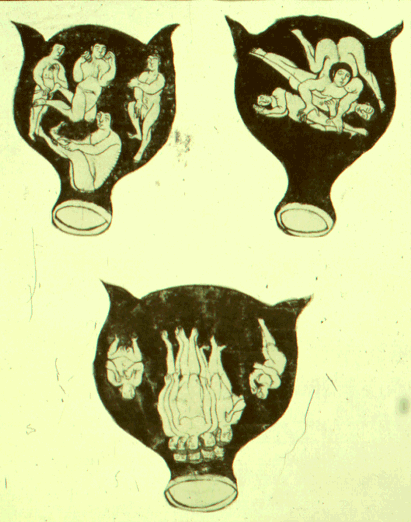
image of fetuses in the womb, medieval/renaissance
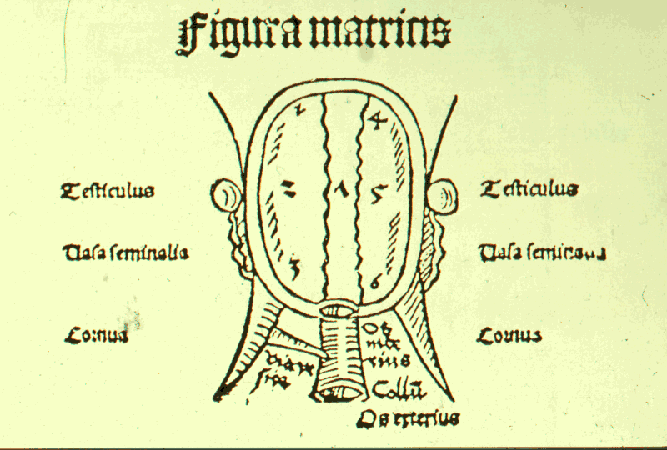 image of medieval female anatomy
"Nature always plans and aims at absolute perfection she would, if possible, constantly bring forth men; and when a woman is born this is a mistake or defect, and contrary to nature's wishes. This is also the case when someone is blind, or lame, or with some other defect, as again with trees, when so many fruits fail to ripen. Nevertheless, since the blame for the defects must be attributed to nature, who has made them what they are, we ought not to despise them or to fail to give them respect which is their due. But to esteem them to be more than they are seems to me to be manifestly wrong."
Interesting that Nature is considered a feminine force, and this feminine force makes mistakes by making women.
Really interesting that it is manifestly wrong to give women more esteem than they deserve because they are just blatant mistakes, when what seems to me to be real effin manifestly wrong is that women are mistakenly created and nature would like to constantly bring forth men. Okay, so nature wants to constantly bring forth men eh? I guess this would happen by men impregnating each-other right? Of course we all know that men have wombs and ovaries and are TOTALLY capable of reproducing all by themselves. YES, SINCE THIS IS POSSIBLE, IT WOULD SEEM THAT WOMEN ARE TOTAL MISTAKES AND HAVE ABSOLUTELY NO PURPOSE ON EARTH, NO PURPOSE WHATSOEVER IN THE BIOLOGICAL REASON FOR LIFE WHICH IS PROCREATION!
I just can't understand this justification. Just can't understand it. I want to go back in time and slap all of these "manifestly wrong" men with a biology book- or wait, no- plain common sense. It would behoove them to use (at the very basic level) their eyes and brain. Maybe, men in this time period were mistakenly born with partial eyes and partial brains. Perhaps they had a lot of neuron misfires making thoughts unable to cross the synaptic cleft rendering this whole reason and logic movement stagnant and useless. And their eyes were unable to transmit images to the corresponding lobes of the brain, so they were immediately faced with a problem on their views...
BUT what the hell would I know??? I'm just an effin mistake.
Tuesday, March 17, 2009
Cereta...
I like her style. I will openly admit that I am attracted to style, whether it's on a garment, in a movie, or written by the pen, I like things with style (sometimes too much for my wallet's good). I really like Cereta's writing style because like she says time is a necklace, I think her letters are necklaces. She strings her words together, like beads, in a way that all of the pieces make an elegant and artfully tasteful piece. It doesn't just hang there, but can be enjoyed and aesthetically appealing.
I don't know how I feel about her disdain for women who concern themselves with fashion. I can see how she would need to fight the mindless consumption of trends and over intensity in the quest for beauty, but I think fashion is another art (think of line, silhouette, color, tonality, emotion, flow, feeling, etc.). I think that an artist (which I consider Cereta to be) should appreciate fashion. Trends and mindless fashion (for example, Louis Vuitton, Uggs)* do not inherently contain pieces of art and must be carefully inspected. I understand Cereta's anger at women who are entirely consumed by looks and perceptions, but please, accept fashion as an art. It seems to me that she was quite proud of the garments she produced- why else would she give the reader such a detailed account of her work?
*there are worthwhile pieces from these labels, just scarce in number... don't hate me please...
(disclaimer, this is from not a renaissance viewpoint)
a little blend of art and fashion
Galliano in galleries?
fashion fight!
how convenient for our class, florence and the f-word
I'll be back!
I like her style. I will openly admit that I am attracted to style, whether it's on a garment, in a movie, or written by the pen, I like things with style (sometimes too much for my wallet's good). I really like Cereta's writing style because like she says time is a necklace, I think her letters are necklaces. She strings her words together, like beads, in a way that all of the pieces make an elegant and artfully tasteful piece. It doesn't just hang there, but can be enjoyed and aesthetically appealing.
I don't know how I feel about her disdain for women who concern themselves with fashion. I can see how she would need to fight the mindless consumption of trends and over intensity in the quest for beauty, but I think fashion is another art (think of line, silhouette, color, tonality, emotion, flow, feeling, etc.). I think that an artist (which I consider Cereta to be) should appreciate fashion. Trends and mindless fashion (for example, Louis Vuitton, Uggs)* do not inherently contain pieces of art and must be carefully inspected. I understand Cereta's anger at women who are entirely consumed by looks and perceptions, but please, accept fashion as an art. It seems to me that she was quite proud of the garments she produced- why else would she give the reader such a detailed account of her work?
*there are worthwhile pieces from these labels, just scarce in number... don't hate me please...
(disclaimer, this is from not a renaissance viewpoint)
a little blend of art and fashion
Galliano in galleries?
fashion fight!
how convenient for our class, florence and the f-word
I'll be back!
Subscribe to:
Posts (Atom)
